
Lonati vs Merz: Why Premium Machinery Is the Only Guarantee for Precise Graduated Compression
author: Jerry Guo
2026-06-08

Graduated compression is the core functional foundation of medical compression socks, anti-thromboembolic stockings, and varicose vein compression hosiery. Unlike ordinary elastic socks that only provide uniform tightness, qualified medical compression products follow a strict biomechanical principle: delivering the maximum pressure at the ankle, with pressure gradually and evenly decreasing upward along the calf, forming a scientific gradient of 100% ankle pressure → 70% calf lower pressure → 40% calf upper pressure. This precise pressure gradient can effectively promote venous blood return, relieve lower limb fatigue, and achieve medical prevention and rehabilitation effects. However, this critical functional effect cannot be achieved by simple material elasticity alone—it entirely depends on high-precision knitting equipment, among which Italy’s Lonati and Germany’s Merz represent the world’s top level of compression hosiery manufacturing technology.
As the global benchmark for professional hosiery knitting machinery, Italian Lonati equipment relies on its self-developed Flexitotal adaptive adjustment system and multi-axis linkage precision control technology, realizing millimeter-level zoning knitting of compression socks. The machine supports real-time dynamic adjustment of yarn tension, needle pitch, and fabric density in different leg segments (ankle, lower calf, upper calf). It can accurately lock the pressure value of each zoning within the error range of ±2mmHg, fully complying with international medical compression standards such as YY/T 0851 and European MDR medical regulations. Lonati’s high-gauge knitting configuration (300N–452N) produces denser and finer fabric structures, ensuring stable elastic recovery and long-term consistent pressure output after repeated wearing and washing, avoiding pressure attenuation and functional failure.
German Merz machinery focuses on industrial precision and mechanical stability, featuring ultra-stable constant-tension knitting systems and digital zoning parameter programming. Different from ordinary equipment’s fixed single knitting parameters, Merz machines can independently set exclusive knitting densities and elastic arrangements for each pressure zone of the stocking. Its high-precision needle control system eliminates yarn tension fluctuations during high-speed operation, ensuring seamless and uniform transition of the overall pressure gradient of the product. For medical-grade compression products requiring strict pressure consistency, Merz equipment can maintain zero deviation of gradient logic in batch mass production, solving the industry pain point of inconsistent pressure between individual products.
In sharp contrast, low-cost ordinary knitting machines are completely unable to meet the manufacturing requirements of medical graduated compression. Such equipment adopts fixed mechanical programming and passive tension control, with no independent zoning adjustment function. It can only achieve overall uniform shrinkage of the fabric, rather than scientific gradient pressure distribution. The pressure error of products made by low-end machines often exceeds ±8–15mmHg, with disordered pressure transition zones, abrupt pressure changes, and uneven local compression. Wearing such unqualified compression socks will not only fail to promote blood return but also easily cause local vascular compression, limb numbness, poor blood circulation, and even aggravate varicose vein symptoms.
In addition to pressure accuracy, the gap in product durability and compliance is also extremely significant. Products from low-cost machines are prone to loose yarn structure, elastic fatigue, and rapid pressure attenuation after short-term use and washing, completely losing medical efficacy. In contrast, Lonati and Merz top-grade equipment, through precise digital parameter control and high-density weaving technology, ensures that each pair of compression socks maintains stable gradient pressure performance for a long time. All products fully meet the testing standards of medical compression hosiery and can pass the certification inspections of various countries.
In conclusion, graduated compression is a kind of mechanical engineering effect realized by precise machine programming, not a simple physical tightening effect of fabrics. Only Italy’s Lonati professional hosiery precision machines and Germany’s Merz high-stability medical-grade knitting equipment can accurately simulate human lower limb biomechanical needs, realize standardized and consistent gradient pressure distribution, and truly guarantee the medical efficacy, safety and durability of compression socks. This is why top medical compression products worldwide uniformly choose Lonati and Merz equipment for production.
 Are Compression Socks Good for Running and Exercise?
 What Compression Socks Should I Wear After Surgery?
 Are Compression Socks Good for Older Adults?
 What Are the Best Compression Socks for Nurses?
 Are Compression Socks Safe to Wear During Pregnancy?
 What Are the Best Compression Socks for Long Flights? | Rongrong Hosiery
 What Are the Best Compression Socks for Standing All Day?
 What Compression Level Do I Need for Varicose Veins? | Rongrong Hosiery
 Should I Choose Knee-High or Thigh-High Compression Socks? | Rongrong Hosiery
 What Size Compression Socks Do I Need?
 How Should Compression Socks Fit? A Guide to Finding the Perfect Fit
 How Do I Measure for Compression Socks? A Complete Sizing Guide
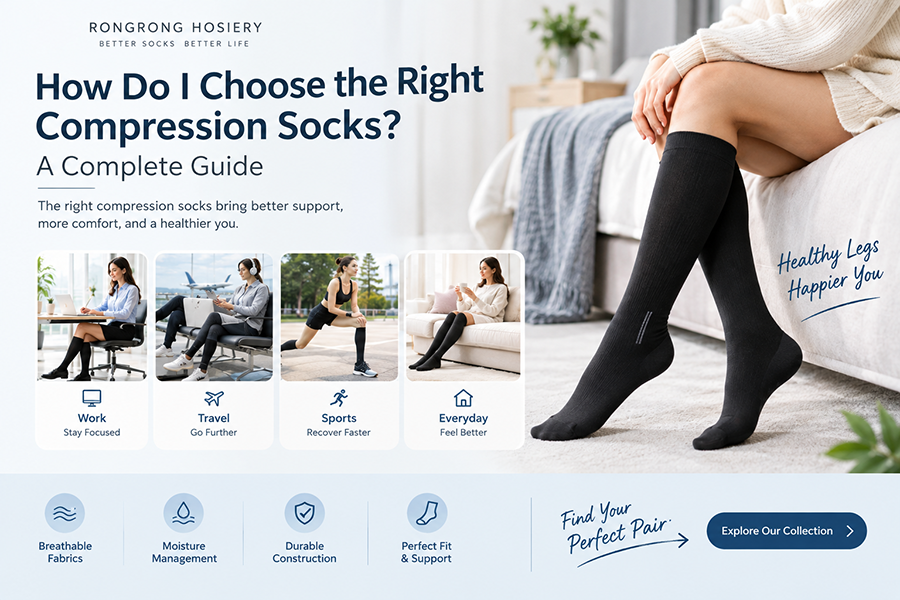 How Do I Choose the Right Compression Socks? A Complete Guide
 What Are the Best Compression Socks for Varicose Veins?
 How Tight Should Compression Socks Be?
 Can You Wear Compression Socks Every Day?
 Can You Wear Compression Socks on a Plane?
 How Often Should You Replace Compression Socks?
 How Do You Put On Compression Stockings?
 When Should You Put On Compression Socks?