
Fabric Materials for Medical Compression Hosiery: Nylon, Spandex & Skin-Friendly Blends
author: Jerry Guo
2026-07-09

Medical compression hosiery relies on high-quality fabric materials to deliver stable pressure, long-lasting wear comfort and professional medical efficacy. The combination of nylon, spandex and skin-friendly blended fabrics has become the core material choice for mainstream medical compression socks. It perfectly balances medical functionality, wearing experience and durability, meeting the rigorous demands of medical rehabilitation, daily care and long-term standing work scenarios.
1. Nylon: The Core Support of Structural Stability
Nylon is the foundational fabric of medical compression hosiery, undertaking the main structural support and shaping function. It features excellent tensile strength and wear resistance, effectively avoiding deformation, pilling and damage after long-term repeated wearing and washing. Different from ordinary textile fabrics, medical-grade nylon has fine and uniform fiber fineness, which can form a flat and delicate fabric surface, ensuring even force on the leg skin.
In terms of medical performance, nylon fabric can stably fix the gradient pressure structure of compression hosiery. It maintains consistent pressure output in key parts such as calves and thighs, avoiding pressure attenuation caused by fabric relaxation. This characteristic ensures that the compression socks can continuously assist venous blood return, relieve leg fatigue, swelling and soreness, and provide reliable auxiliary care for varicose veins and postoperative rehabilitation.
2. Spandex: The Key to Flexible Compression & Perfect Fit
Spandex is an indispensable elastic core material for medical compression hosiery, determining the elasticity, fit and wearing flexibility of the product. Medical-grade spandex has super high elasticity and excellent resilience, which can stretch freely with leg movements such as walking, standing and squatting, without binding or restricting daily activities.
Its precise elastic recovery performance enables the compression hosiery to fit tightly with the leg curve all the time, realizing the professional gradient pressure design (20-30mmHg, 30-40mmHg and other conventional medical pressure values). It can accurately act on superficial veins, effectively prevent blood stasis. Meanwhile, spandex’s soft elastic texture avoids excessive squeezing and stiff binding, greatly improving the wearing comfort of medical compression socks, and is suitable for long-term wearing by patients and office workers.
3. Skin-Friendly Blends: Upgrade Wearing Experience & Safety Performance
On the basis of nylon and spandex base materials, professional skin-friendly blended fabrics further optimize the comprehensive performance of medical compression hosiery. Through scientific fiber proportion blending, the fabrics integrate the wear resistance of nylon, the elasticity of spandex and the soft, breathable and skin-friendly advantages of high-quality auxiliary fibers, solving the pain points of ordinary compression socks such as stuffiness, dry skin and allergic itching after long wearing.
The skin-friendly blended material has excellent air permeability and moisture wicking properties, which can quickly export sweat and moisture on the leg surface, keep the skin dry and breathable all day long, and effectively avoid bacterial growth and stuffy skin problems. In addition, the blended fabric has passed strict skin safety tests, with no irritation, no peculiar smell, and low sensitization. It is friendly to sensitive skin, pregnant women, postoperative rehabilitation groups and other special crowds, realizing safe and comfortable medical care.
4. Advantages of Combined Materials: Professional & Durable Medical-Grade Performance
The matched use of nylon, spandex and skin-friendly blends endows medical compression hosiery with irreplaceable professional advantages. First, the overall fabric has strong shape retention, which is not easy to loose and fail after frequent cleaning and long-term use, ensuring long-term stable medical compression effect. Second, the fabric is soft and thick moderately, not easy to hook silk and wear, with longer service life and higher cost performance.
Moreover, the integrated material design conforms to international medical textile standards. It is widely applicable to medical rehabilitation care, nurse standing protection, outdoor sports leg protection, daily leg maintenance and other scenarios, meeting the diverse customized needs of different pressure levels, sizes and crowds.
Summary
Nylon provides stable structural support, spandex supplies flexible and accurate compression, and skin-friendly blended fabrics optimize safety and comfort. The three types of materials complement each other perfectly, building the core quality of high-standard medical compression hosiery. It not only meets the professional medical auxiliary treatment needs, but also realizes comfortable and durable daily wearing, being the preferred material solution for high-quality medical compression hosiery products.
 What Are the Best Compression Socks for Travel and Walking?
 Are Compression Socks Good for Running and Exercise?
 What Compression Socks Should I Wear After Surgery?
 Are Compression Socks Good for Older Adults?
 What Are the Best Compression Socks for Nurses?
 Are Compression Socks Safe to Wear During Pregnancy?
 What Are the Best Compression Socks for Long Flights? | Rongrong Hosiery
 What Are the Best Compression Socks for Standing All Day?
 What Compression Level Do I Need for Varicose Veins? | Rongrong Hosiery
 Should I Choose Knee-High or Thigh-High Compression Socks? | Rongrong Hosiery
 What Size Compression Socks Do I Need?
 How Should Compression Socks Fit? A Guide to Finding the Perfect Fit
 How Do I Measure for Compression Socks? A Complete Sizing Guide
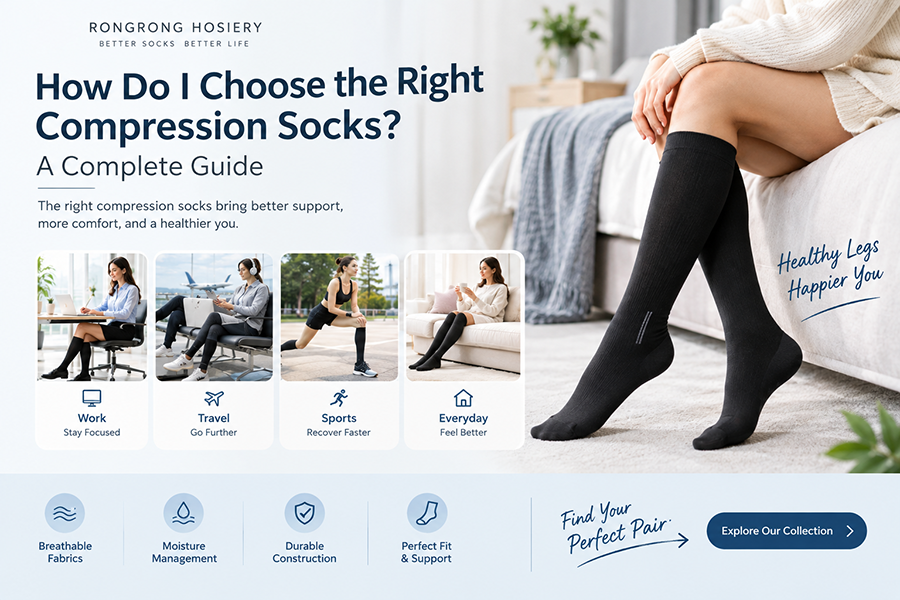 How Do I Choose the Right Compression Socks? A Complete Guide
 What Are the Best Compression Socks for Varicose Veins?
 How Tight Should Compression Socks Be?
 Can You Wear Compression Socks Every Day?
 Can You Wear Compression Socks on a Plane?
 How Often Should You Replace Compression Socks?
 How Do You Put On Compression Stockings?