
How to identify high-quality compression socks

Compression socks are now a must-have for office workers, runners, pregnant women, and anyone who stands or sits for hours. A pair of high-quality compression socks can effectively relieve leg fatigue, improve blood circulation, and prevent varicose veins.
However, many companies flood the market with various compression socks of uneven quality. Many low-quality products either have no compression effect at all or cause tightness, numbness and poor blood circulation. So, how to distinguish high-quality compression socks from inferior ones? Today, we will teach you a few key ways to identify compression socks.
These tips will help you choose safe, cost-effective socks with ease.
1. Check the Standard Compression Grade & Data Accuracy
Graduated compression provides the main benefit of compression socks. This is the key difference from regular tight socks. High-quality compression socks show clear, standard pressure values in mmHg.
They use a scientific gradient design.
Pressure is highest at the ankle.
It gradually decreases up the calf.
Pressure at the thigh is the lowest. This design can precisely push blood back to the heart and achieve a real decompression effect.
Reliable products clearly list compression grades on the packaging.
Examples include 15–20 mmHg for daily health care.
20–30 mmHg helps with moderate fatigue and sports recovery.
30–40 mmHg is for medical support. In contrast, inferior compression socks have no clear pressure data, or only vague slogans such as "super compression".
Most of them use a uniform tight fit. This can bind the legs, reduce blood flow, and cause swelling. It can also cause numbness after long wear.
2. Observe the Fabric Material & Woven Craft
The fabric determines the comfort, durability and compression stability of compression socks. Manufacturers usually make high-quality compression socks from stretchy blended materials. They often use nylon and spandex. The fibers are mixed in a balanced ratio.
The fabric is soft, skin-friendly, breathable, and sweat-absorbent. It has delicate, tight weaving. It has no rough threads or hard edges. It will not rub or scratch your skin during prolonged wear.
In addition, premium products adopt fine seamless weaving technology at the toe and heel. The toe cap is flat and smooth, with no thick threads.
It helps prevent toe squeezing.
The heel is thickened and wrapped.
It stays on better and helps protect the heel from friction.
On the contrary, low-quality compression socks use coarse, inferior fibers. They feel rough and do not breathe well. Your feet may sweat easily and feel stuffy. The weaving is loose and uneven.
The stretch fades quickly after several wears. The compression effect disappears completely. There are obvious loose threads and rough seams.
3. Test Elasticity & Recovery Performance
Excellent elasticity and stable recovery are key symbols of high-quality compression socks. You can test it with a simple stretch. Stretch the socks sideways and up and down.
The pull should feel even. The stretch should be moderate. It should not feel too hard or too loose.
After you release the stretched socks, they quickly rebound and return to their original shape. They do not relax, deform, or become slack.
Low-quality products have uneven elasticity. Some are too tight and hard to wear. They can restrict the legs.
Others are too loose with weak stretch. They provide no compression at all. After one or two stretches, or after a short time wearing them, they can deform permanently.
They may become loose and baggy. They can also lose the core compression function. High-quality compression socks keep steady elasticity and compression after many washes and long use. They do not deform or loosen easily.
4. Verify Professional Certification & Brand Qualification
Formal, high-quality compression socks are professional, functional products, not everyday socks.
They have strict production standards and certification requirements. Regular, qualified products pass medical or textile safety certifications.
They include full production details on the packaging.
They list ingredients, pressure grade labels, and batch numbers.
They also support formal quality inspections.
Small workshops with no formal qualifications produce many inferior compression socks on the market. They have no professional certification and no clear product labels.
Some safety indicators are unqualified, like formaldehyde and color fastness.
Wearing them may cause skin allergies, itching, and other problems. Choosing certified brand products can effectively avoid safety risks and ensure the effectiveness of compression socks.
5. Experience the Wearing Fit & Practical Effect
The ultimate standard for judging quality is the actual wearing experience. Wearing high-quality compression socks provides gentle wrapping and pressure.
Your legs feel supported, and your muscles feel relaxed. There is no tightness, restraint, or swelling. After wearing them for a full day of office work, walking, or sports, calf soreness and swelling are greatly reduced. Your legs won’t feel numb or tired.
Inferior products may feel like ordinary socks with no pressure.
Or they may apply too much uneven pressure.
This can tightly bind the legs and reduce normal blood flow.
After wearing them, legs may feel more swollen and sore. In addition, high-quality compression socks do not slip down, roll up, or bunch during walking and exercise.
They fit well.
Low-quality socks often slip down and roll at the edges.
This affects comfort and overall performance.
Final Summary
A good pair of compression socks is practical for leg care, while poor products are useless and can harm leg health. When purchasing, don’t blindly pursue low prices! Focus on standard compression data, high-quality fabric craftsmanship, stable elasticity recovery, formal qualification certification and comfortable wearing experience.
Only high-quality compression socks can help protect leg circulation. They can reduce fatigue. They can keep your legs relaxed and healthy all year round.
 Are Compression Socks Good for Running and Exercise?
 What Compression Socks Should I Wear After Surgery?
 Are Compression Socks Good for Older Adults?
 What Are the Best Compression Socks for Nurses?
 Are Compression Socks Safe to Wear During Pregnancy?
 What Are the Best Compression Socks for Long Flights? | Rongrong Hosiery
 What Are the Best Compression Socks for Standing All Day?
 What Compression Level Do I Need for Varicose Veins? | Rongrong Hosiery
 Should I Choose Knee-High or Thigh-High Compression Socks? | Rongrong Hosiery
 What Size Compression Socks Do I Need?
 How Should Compression Socks Fit? A Guide to Finding the Perfect Fit
 How Do I Measure for Compression Socks? A Complete Sizing Guide
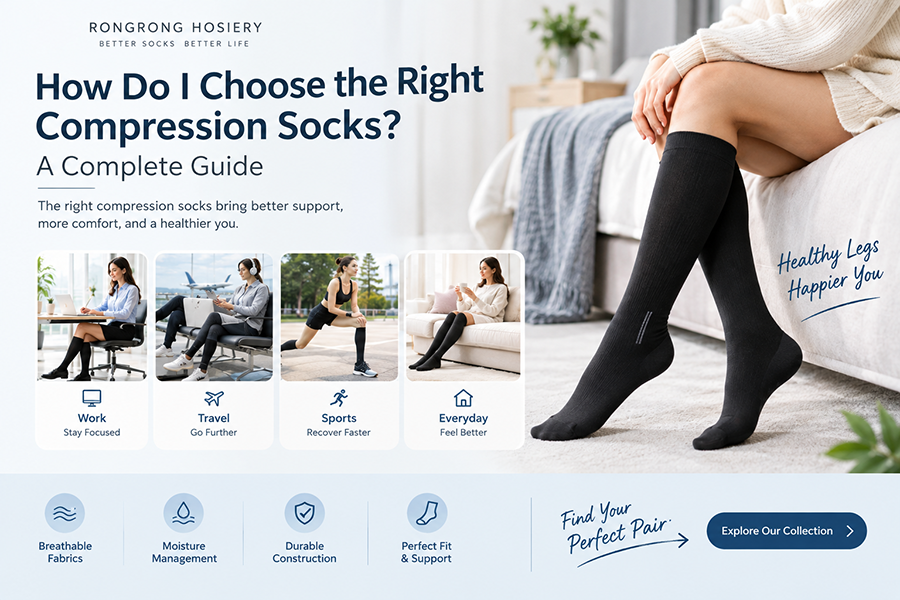 How Do I Choose the Right Compression Socks? A Complete Guide
 What Are the Best Compression Socks for Varicose Veins?
 How Tight Should Compression Socks Be?
 Can You Wear Compression Socks Every Day?
 Can You Wear Compression Socks on a Plane?
 How Often Should You Replace Compression Socks?
 How Do You Put On Compression Stockings?
 When Should You Put On Compression Socks?