
Medical Compression Socks-Complete Guide to Choosing the Right Compression Level
author: Jerry Guo
2026-08-07
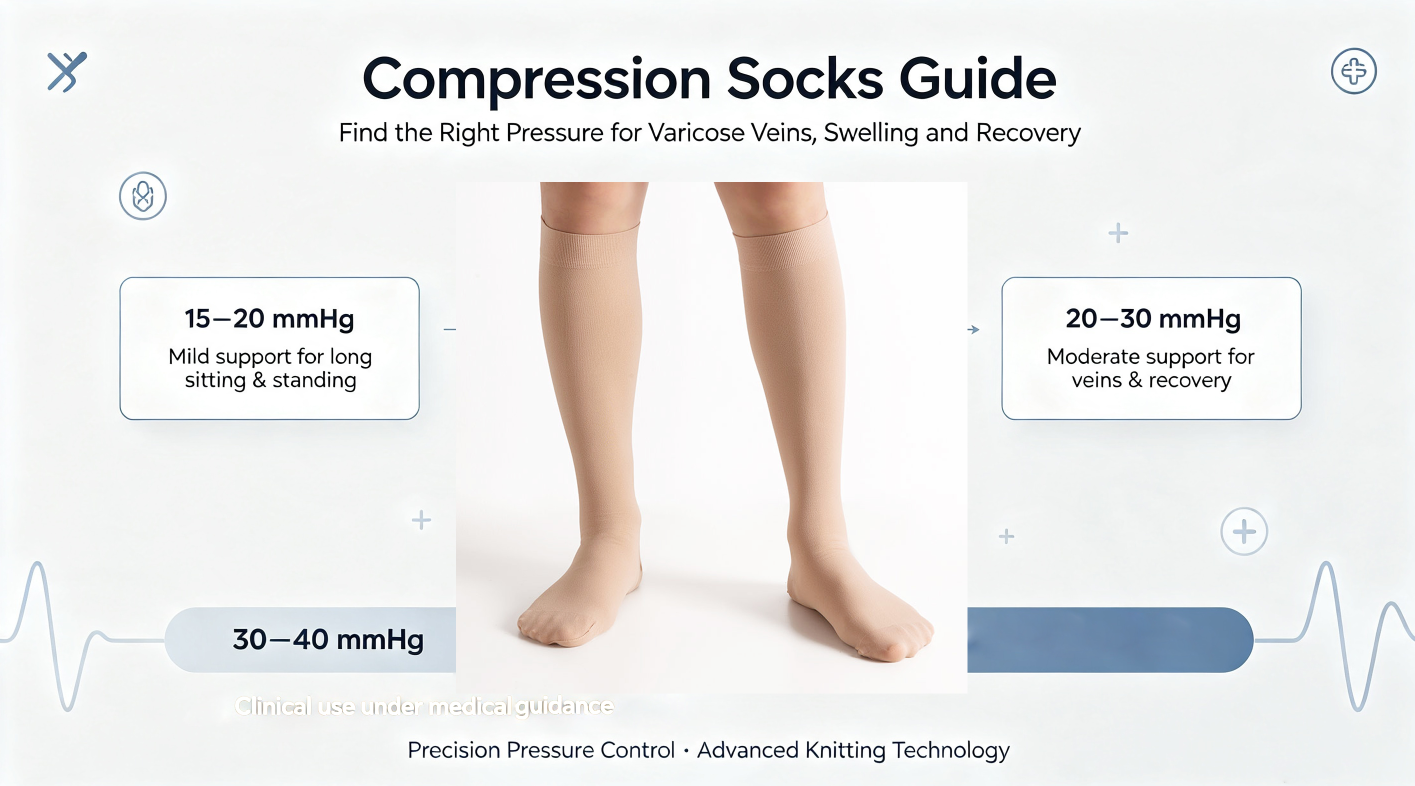
Differences Between Mainstream Compression Levels (15-20 / 20-30 / 30-40 mmHg)
Medical compression socks are classified by pressure intensity, with three core mainstream grades covering daily prevention, daily treatment and severe clinical rehabilitation. Each level has clear applicable scenarios and functional positioning:
1. 15-20 mmHg (Light Preventive Compression)
This is the mildest medical-grade compression level, focusing on daily prevention and mild comfort care. It provides gentle gradient pressure without causing tight binding or discomfort, suitable for early mild leg discomfort and daily venous health maintenance. It is the most popular entry-level compression grade for daily civilian use.
2. 20-30 mmHg (Moderate Therapeutic Compression)
As the most versatile and doctor-recommended mainstream therapeutic grade, this compression level balances efficacy and comfort. It can effectively improve obvious leg swelling, soreness and venous stasis problems, and has definite auxiliary therapeutic effects on mild to moderate venous lesions. It is the preferred grade for most sub-health leg problems and routine post-surgical recovery.
3. 30-40 mmHg (Firm Clinical Compression)
This high-intensity medical compression grade belongs to professional clinical therapeutic equipment, with strong pressure regulation capability. It is only applicable to severe venous problems and professional postoperative rehabilitation scenarios, and is usually recommended and worn under the guidance of a professional physician. It is not suitable for daily casual wear to avoid excessive compression causing discomfort.
How to Choose the Right Compression Level by Condition & Scenario
1. For Varicose Veins
For early-stage varicose veins (slight vein protrusion, no obvious swelling or pain), 15-20 mmHg is ideal for daily prevention and symptom relief, effectively preventing the deterioration of venous dilation. For patients with obvious moderate varicose veins (obvious vein bulging, frequent leg soreness, mild swelling), 20-30 mmHg is the best choice, which can effectively compress dilated veins, promote blood circulation and relieve lesion symptoms. For severe varicose veins with recurrent swelling and pain, follow medical advice to choose 30-40 mmHg professional therapeutic compression socks.
2. For Sedentary & Long-Standing Occupations
Office workers, drivers, teachers, medical staff and other groups who maintain sitting or standing postures for a long time are prone to leg blood stasis, fatigue and mild edema. For daily fatigue relief and venous health prevention, 15-20 mmHg light compression socks are sufficient to relieve leg heaviness and prevent venous stasis. For those who work long hours every day with frequent leg swelling and soreness, upgrading to20-30 mmHg can achieve better circulation improvement and fatigue relief effects.
3. For Post-Surgery Recovery
For routine lower limb minor surgery, varicose vein minimally invasive surgery and postpartum leg recovery, 20-30 mmHg compression socks are the mainstream choice, which can reduce postoperative swelling, prevent venous thrombosis, and accelerate postoperative blood circulation recovery. For major lower limb surgery, severe venous thrombosis recovery and lymphedema rehabilitation, 30-40 mmHg high-grade medical compression socks are required for professional auxiliary rehabilitation under medical supervision to ensure standardized pressure repair.
4. For Poor Blood Circulation
People with general poor lower limb circulation, cold legs, and mild daily edema can choose 15-20 mmHg to activate blood circulation and improve daily sub-health symptoms. For those with long-term poor circulation, persistent leg swelling, and heavy leg pressure, 20-30 mmHg can significantly improve venous return efficiency and solve chronic blood stasis problems. Severe circulatory disorders accompanied by pathological edema need professional medical evaluation and matching 30-40 mmHg high-compression rehabilitation socks.
Our Factory Advantages for Medical Compression Socks
With 30 years of professional sock manufacturing experience, our factory has long focused on the R&D and production of high-standard medical compression socks, accumulating mature production technology and strict quality control systems. Different from ordinary ordinary socks manufacturers, we adoptprecision gradient pressure control technology to ensure that each pair of medical compression socks strictly follows the standard ankle-to-calf pressure drop rule, with accurate pressure values, uniform stress, and no local excessive or insufficient compression, ensuring stable medical care efficacy.
We adopt advanced high-density knitting technology and high-elastic skin-friendly functional yarns. The finished socks are flat and delicate without floating threads, breathable and sweat-wicking, with strong elasticity and durability. While ensuring accurate medical compression performance, they greatly improve wearing comfort and avoid the tightness, stuffiness and skin friction problems of inferior compression socks. All products comply with international medical textile standards, covering 15-20 mmHg, 20-30 mmHg, 30-40 mmHg full pressure grades, supporting customized sizes and processes, and providing reliable high-quality medical compression sock solutions for global customers.
Conclusion
The core of choosing medical compression socks is to match the compression level with personal leg conditions and usage scenarios. 15-20 mmHg is for daily prevention, 20-30 mmHg is for conventional treatment and rehabilitation, and 30-40 mmHg is for professional clinical adjuvant therapy. Choosing standardized, precisely pressured medical compression socks is crucial to ensuring use effect and safety. With professional manufacturing strength and strict quality control, we provide high-performance, comfortable and durable medical compression socks to protect users' lower limb venous health.
 Are Compression Socks Good for Running and Exercise?
 What Compression Socks Should I Wear After Surgery?
 Are Compression Socks Good for Older Adults?
 What Are the Best Compression Socks for Nurses?
 Are Compression Socks Safe to Wear During Pregnancy?
 What Are the Best Compression Socks for Long Flights? | Rongrong Hosiery
 What Are the Best Compression Socks for Standing All Day?
 What Compression Level Do I Need for Varicose Veins? | Rongrong Hosiery
 Should I Choose Knee-High or Thigh-High Compression Socks? | Rongrong Hosiery
 What Size Compression Socks Do I Need?
 How Should Compression Socks Fit? A Guide to Finding the Perfect Fit
 How Do I Measure for Compression Socks? A Complete Sizing Guide
 How Do I Choose the Right Compression Socks? A Complete Guide
 What Are the Best Compression Socks for Varicose Veins?
 How Tight Should Compression Socks Be?
 Can You Wear Compression Socks Every Day?
 Can You Wear Compression Socks on a Plane?
 How Often Should You Replace Compression Socks?
 How Do You Put On Compression Stockings?
 When Should You Put On Compression Socks?