
Who Is Suitable For Wearing Medical And Sports Compression Socks
author: Jerry Guo
2026-05-30

Medical and sports compression socks are functional elastic hosiery with different compression strengths and design purposes. Medical compression socks focus on venous health care and disease prevention and rehabilitation, while sports compression socks are dedicated to improving exercise performance and accelerating physical recovery. Due to their distinct functional orientations, their suitable wearing groups are also differentiated. Below is a detailed classification of the applicable crowds for these two types of compression socks.
I. Suitable Crowds for Medical Compression Socks
Medical compression socks are designed based on the human venous blood return principle, with gradient compression from the ankle to the thigh. They are mainly used to prevent and improve lower limb venous circulation disorders, suitable for people with poor venous blood return, high risk of varicose veins and venous discomfort.
1. People with long-term sedentary or standing work
Office workers, teachers, sales staff, bank clerks, traffic police and other groups need to keep sitting or standing for more than 8 hours a day. Long-term fixed posture will cause the lower limb venous blood to stagnate, increase venous pressure, and easily lead to leg soreness, swelling, numbness and other discomforts, and even induce varicose veins over time. Medical compression socks can effectively promote venous blood return, reduce blood stasis, and relieve daily leg fatigue and swelling for this group.
2. Patients with mild varicose veins and venous insufficiency
For people who have developed mild varicose vein symptoms such as superficial venous dilation, leg blue veins protruding, and calf heaviness, as well as patients with chronic venous insufficiency, standardized wearing of medical compression socks can compress dilated veins, reduce venous reflux resistance, alleviate disease progression, and relieve persistent leg swelling and pain caused by poor circulation. It is also an essential auxiliary physical rehabilitation method for conservative treatment of venous diseases.
3. Postoperative and bedridden rehabilitation patients
Patients after lower limb surgery, abdominal surgery or orthopedic surgery, as well as long-term bedridden patients, have reduced lower limb activity and slowed blood circulation, which is prone to deep vein thrombosis, a serious postoperative complication. Medical compression socks can activate venous blood circulation, reduce the risk of thrombosis, and help patients recover lower limb venous circulation function as soon as possible. In addition, it is also applicable to the rehabilitation period of varicose vein surgery, which can prevent postoperative recurrence and reduce limb edema.
4. Pregnant women and puerperae
During pregnancy, the increase of progesterone will relax venous blood vessels, and the enlarged uterus will compress the pelvic and lower limb veins, resulting in blocked lower limb blood return, making pregnant women prone to leg swelling, varicose veins and hemorrhoids. Puerperae with weak physical function and less activity also have a high risk of venous stasis. Wearing professional medical compression socks during pregnancy and puerperium can safely improve lower limb circulation, relieve edema, and prevent gestational varicose veins.
5. People with frequent leg edema and fatigue
Some people have no obvious vascular lesions, but they often suffer from calf swelling, soreness and heavy legs after walking, walking for a long time or staying up late. This kind of physiological circulation discomfort can be effectively relieved by wearing medical compression socks, which can improve lower limb blood and oxygen supply and eliminate accumulated lactic acid and metabolic waste.
II. Suitable Crowds for Sports Compression Socks
Sports compression socks adopt high-elastic breathable fabric and professional sports gradient compression design, focusing on muscle support, vibration reduction, fatigue relief and post-exercise recovery. They are suitable for all kinds of sports enthusiasts and people with high-intensity physical activity, with stronger pertinence to exercise scenarios.
1. Long-distance endurance sports enthusiasts
Runners, marathon enthusiasts, long-distance walkers, cyclists and other endurance sports groups are the core applicable crowds of sports compression socks. During long-term continuous exercise, the lower limb muscles vibrate violently repeatedly, which is easy to cause muscle strain, soreness and fatigue. Sports compression socks can tightly wrap the calf muscles, reduce muscle jitter and vibration loss, maintain muscle stability, and effectively delay the occurrence of exercise fatigue. At the same time, they can accelerate blood circulation, increase muscle oxygen supply, and improve endurance and exercise performance.
2. High-intensity intermittent sports athletes
People who often engage in basketball, football, badminton, volleyball, sprint and other high-intensity intermittent sports have frequent sudden acceleration, deceleration and jumping movements, which bring great pressure to the calf muscles and Achilles tendon. Sports compression socks can provide effective support for muscles and tendons, reduce the risk of muscle strain, cramp and sports injury, and help athletes maintain stable physical state during high-intensity confrontation.
3. Fitness and strength training lovers
Gym fitness enthusiasts, strength trainers and cross-training practitioners often need to complete squat, leg press, lunge and other lower limb strength training. These movements will cause instantaneous surge of lower limb venous pressure and muscle congestion. Wearing sports compression socks can relieve muscle congestion and swelling during training, reduce muscle soreness after exercise, and speed up the discharge of metabolic waste such as lactic acid, shortening the physical recovery cycle.
4. People with long-term outdoor walking and hiking
Outdoor hikers, mountaineers, tour guides and other groups who need to walk and stand outdoors for a long time belong to high-consumption physical activity crowds. Long-time walking will lead to calf muscle fatigue and blood stasis. Sports compression socks with good breathability and elasticity can adapt to outdoor complex environments, relieve leg pressure, prevent swelling and soreness, and keep the legs in a comfortable state during long-time outdoor activities.
5. Sports rehabilitation and daily muscle maintenance crowds
Athletes or sports lovers who have mild lower limb muscle strain and are in the rehabilitation period can wear sports compression socks to assist muscle repair and avoid secondary damage caused by muscle relaxation and instability. In addition, ordinary people who want to maintain lower limb muscle state, prevent muscle sagging and relieve daily mild leg fatigue can also wear sports compression socks for daily care.
III. Key Differences in Applicable Scenarios Reminder
It is crucial to distinguish the two types of compression socks: medical compression socks focus on circulation improvement and disease prevention and rehabilitation, with standard and stable compression strength, suitable for daily sedentary and standing crowds and people with venous health problems; sports compression socks focus on sports protection and fatigue recovery, with more breathable and flexible fabric, suitable for various exercise and high physical consumption scenarios. Choosing targeted compression socks according to personal needs can maximize the functional effect.
 Are Compression Socks Good for Running and Exercise?
 What Compression Socks Should I Wear After Surgery?
 Are Compression Socks Good for Older Adults?
 What Are the Best Compression Socks for Nurses?
 Are Compression Socks Safe to Wear During Pregnancy?
 What Are the Best Compression Socks for Long Flights? | Rongrong Hosiery
 What Are the Best Compression Socks for Standing All Day?
 What Compression Level Do I Need for Varicose Veins? | Rongrong Hosiery
 Should I Choose Knee-High or Thigh-High Compression Socks? | Rongrong Hosiery
 What Size Compression Socks Do I Need?
 How Should Compression Socks Fit? A Guide to Finding the Perfect Fit
 How Do I Measure for Compression Socks? A Complete Sizing Guide
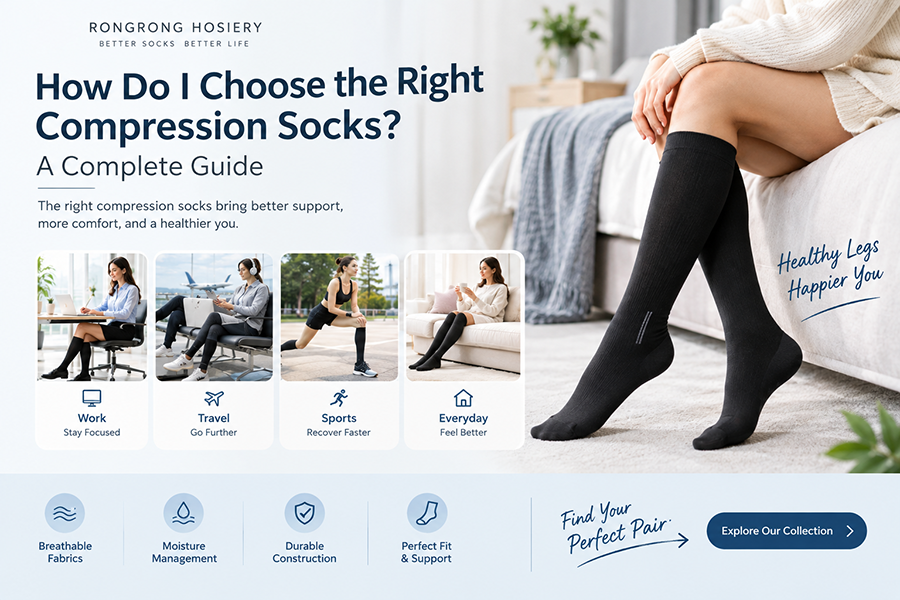 How Do I Choose the Right Compression Socks? A Complete Guide
 What Are the Best Compression Socks for Varicose Veins?
 How Tight Should Compression Socks Be?
 Can You Wear Compression Socks Every Day?
 Can You Wear Compression Socks on a Plane?
 How Often Should You Replace Compression Socks?
 How Do You Put On Compression Stockings?
 When Should You Put On Compression Socks?